Process · 18 Aug 2026 · 3 min read
How we staff an engagement: engagement lead, project manager, technical lead
The people on a project matter as much as the stack. Here's how we size a team from a shared bench, with a named engagement lead, project manager and technical lead on every engagement.
A named lead for every engagement
Every engagement we run has a named engagement lead, project manager and technical lead, with the team sized from a shared bench rather than hired fresh for each contract. That structure exists because the alternative, a rotating cast of contractors with no single owner, is exactly what breaks down on the kind of long, multi-month engagements we take on.
Sizing from a shared bench also means a team isn't fixed at kickoff and frozen from there. A shared DevOps function we ran brought several clients' AWS estates under Terraform, with CI/CD pipelines to container registries and ECS, CloudWatch monitoring, and a blue-green front-end deployment for one of them.
That bench spans full-stack, frontend and backend engineers, DevOps engineers, product managers and project coordinators, with the mix sized to what an engagement's scope actually calls for rather than fixed in advance.
Discover, design, then develop and deploy in the open
Our process runs in four stages. Discover: we learn the business and its challenges. Design: we plan the tech or support solution that actually fits it, rather than the one that's easiest to staff. Develop & Deploy: agile execution, with timely delivery rather than a single release at the end. Support & Evolve: we stay with the client after launch to grow and optimise what's shipped, instead of moving the team on to the next contract.
That last stage matters as much as the first: we stay with you after launch to support and evolve what's shipped, not just hand it over. The same discipline runs earlier too. On a rescue of a subscription trading-community platform, delivery ran through reviewed pull requests with daily written updates for the length of the engagement, so the client always had visibility into what the team was doing and why, even as priorities moved from restoring login and billing to a later performance refactor.
The same structure shows up in smaller, faster-moving work too. On an AI-assisted scheduling tool rescued days before a customer demo, changes were reviewed live with the client and pushed incrementally rather than batched into a single handover, including switching the AI chat to another model provider through LangChain when the original one hit a capacity outage. That is the kind of direct access to a technical lead a named-role structure is built to provide, instead of requests disappearing into a support queue.
A named lead isn't a title on a slide. It's who answers when something breaks, and who stays with you after launch to support and evolve what's shipped.
Staying on after the deadline is the actual test
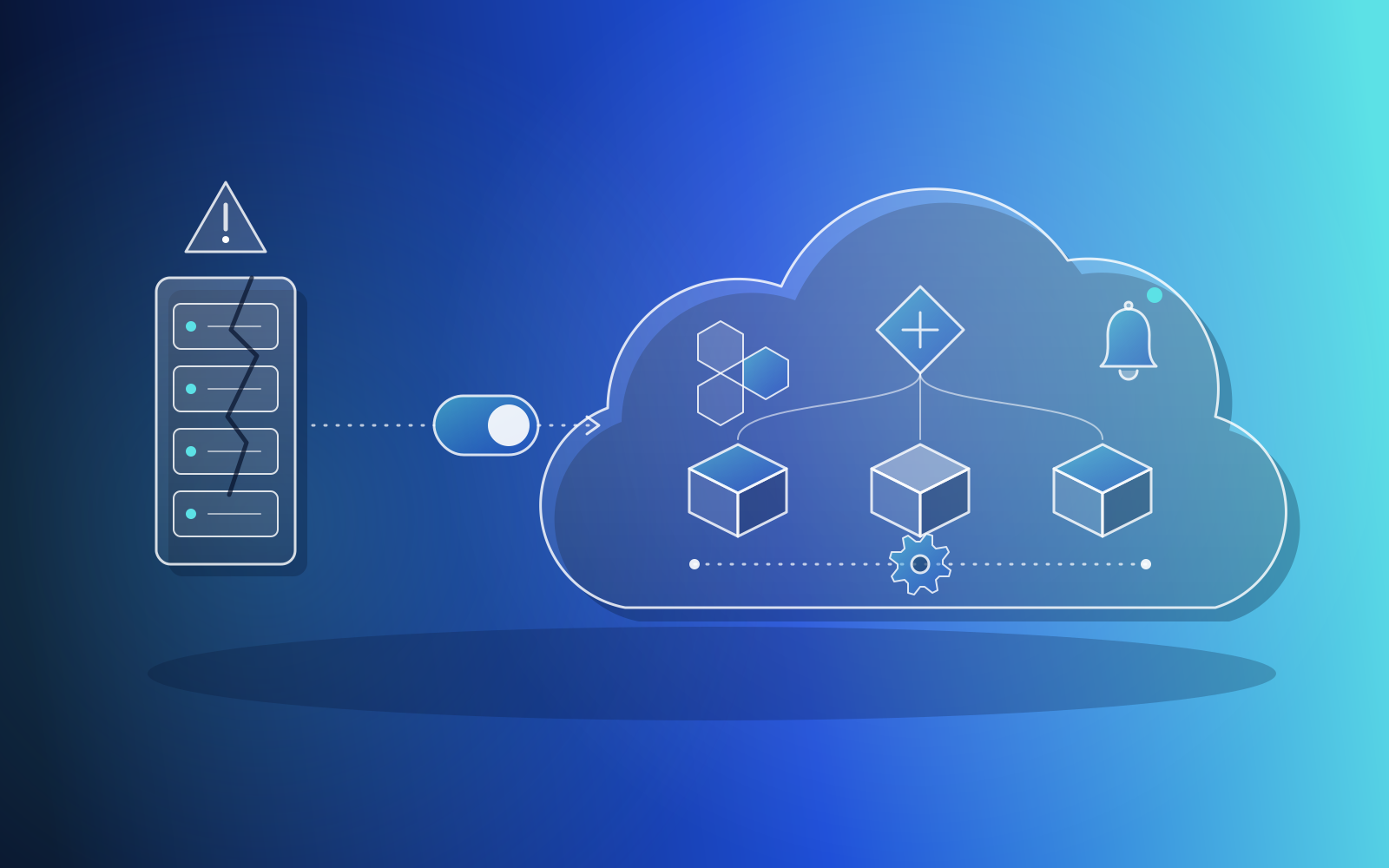
The clearest evidence of how we staff is what happens after the first launch. An internal AI platform we extended for a conversion-optimisation agency ran as an engagement from September 2025 to July 2026, with the client assigning new features through mid-2026. The client repeatedly praised progress along the way. A cloud migration for three Canadian clients turned into an ongoing arrangement. We moved them off fragile single-server setups that crashed under load onto Terraform-managed AWS environments with CI/CD, autoscaling and alerting, cutting over with DNS switches so production traffic was never touched until tested, and the team continues as on-call escalation, handling outages, cost tuning and security incidents as they come up.
That's what "sized from a shared bench" means in practice: a team big enough to move fast at the start of an engagement, with a named engagement lead, project manager and technical lead on it from day one. After launch, we stay with you to support and evolve what's shipped.
- Process
- Delivery
- Staffing
Related services
Related case studies
FinanceSaaS
Trading community platform rescue and refactor
We rescued a subscription trading-community platform that a previous developer had left unable to log users in. We rebuilt the missing APIs, fixed billing, uploads and real-time features, and cut page-load API traffic from hundreds of calls to one.
MarketingSaaS
AI-powered conversion-optimisation agency platform
Extended an e-commerce optimisation agency's internal AI platform with real-time test-data sync, prioritisation and sprint planning, automated client slide decks, LLM research agents and embedding-based retrieval groundwork, and cut the LLM cost of its review-mining pipeline.
OtherInfrastructure
Cloud migration and production DevOps support
We migrated three client products from fragile single-server setups to Terraform-managed AWS environments with CI/CD, autoscaling and alerting, cutting over with DNS switches so production traffic was never touched until tested. The team continues as on-call escalation, handling outages, cost tuning and security incidents.